
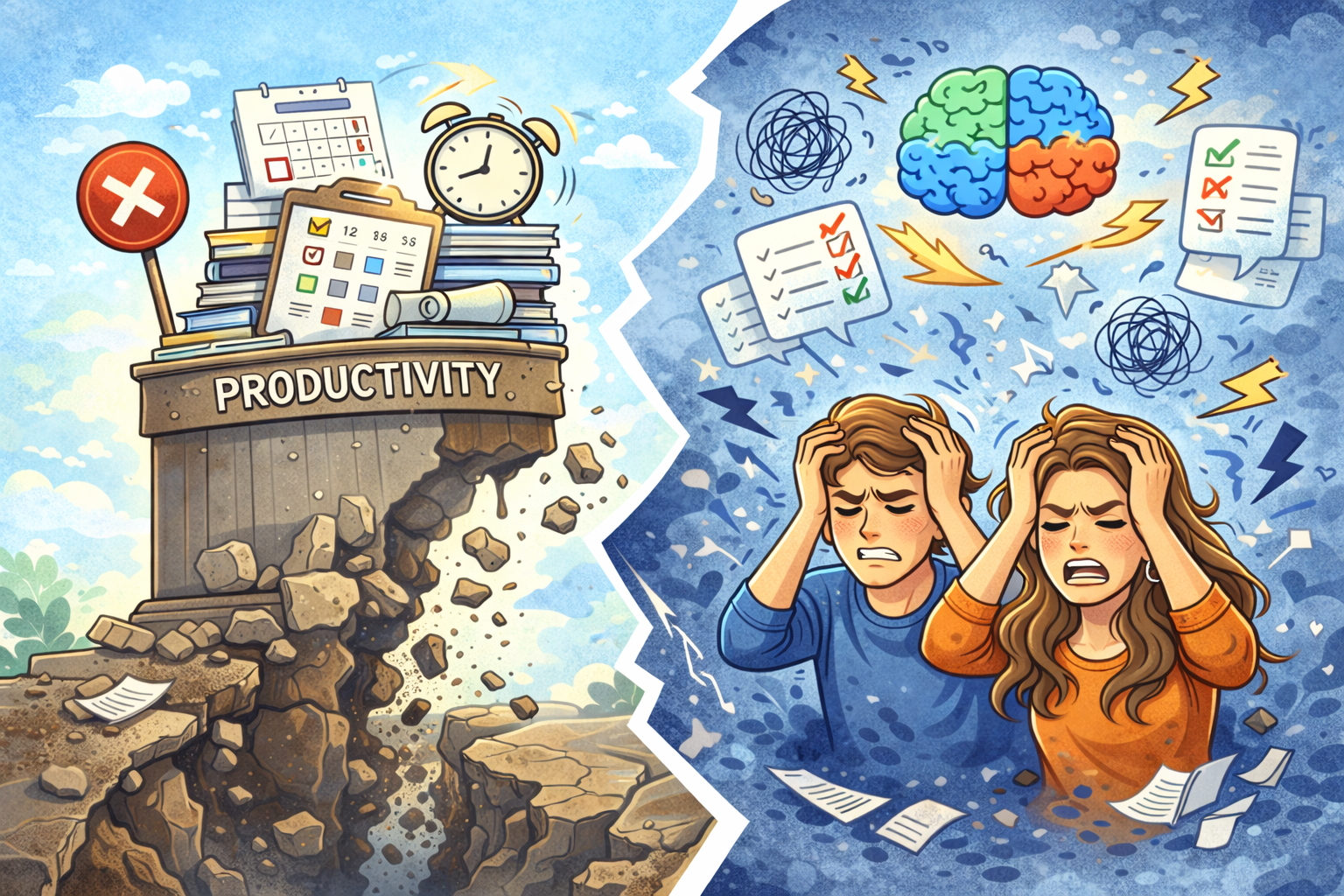
Productivity advice is everywhere. Set clearer goals. Build better habits. Wake up earlier. Push through resistance. Stay consistent.
For many people, these ideas are helpful. For many autistic and ADHD adults, they quietly fail — not because we lack motivation or discipline, but because most productivity systems were never designed with our nervous systems in mind.
This isn’t a personal failing. It’s a design problem.
Productivity Culture Assumes a Stable Nervous System
Most mainstream productivity advice assumes that people start their day with roughly the same internal conditions. Enough energy. Predictable focus. Emotional neutrality. A nervous system that responds well to pressure and incentives.
Neurodivergent nervous systems don’t work that way.
Autistic and ADHD brains are state-dependent, meaning our capacity to focus, initiate tasks, and sustain effort changes based on sensory input, emotional load, sleep, health, and environmental demands. What works beautifully one day may collapse entirely the next — even when the task hasn’t changed.
Research on ADHD and executive functioning consistently shows that performance is highly sensitive to context, stimulation, and emotional state, not just intention or planning (Barkley; Sonuga-Barke). Similarly, autistic adults often experience fluctuating capacity related to sensory load and cognitive demand rather than motivation (Pellicano et al.).
Mainstream productivity systems rarely account for this variability.
Executive Function Is Not a Moral Trait
A lot of productivity advice quietly moralizes executive function. If you can’t start the task, you must be procrastinating. If you can’t finish it, you must not care enough. If you struggle with consistency, you must lack discipline.
But executive function is a set of neurological skills, not character traits.
Executive function includes things like task initiation, working memory, planning, time awareness, and emotional regulation. These systems are reliably different in autistic and ADHD brains. Difficulty starting a task does not mean someone is lazy. It often means the brain cannot bridge the gap between intention and action without additional support.
Studies show that adults with ADHD, in particular, experience impaired task initiation even when motivation is high, especially for tasks that are low-interest or emotionally loaded (Barkley). Autistic adults may experience shutdown or inertia when demands exceed available cognitive or sensory resources (Murray et al.).
Productivity advice that ignores this reality tends to produce shame, not results.
Discipline-Based Systems Often Increase Burnout
Many popular systems rely on external pressure: deadlines, accountability partners, streaks, or self-imposed consequences. These can work in the short term, especially for people whose nervous systems respond well to urgency.
For many neurodivergent adults, pressure backfires.
Chronic exposure to stress-based motivation can lead to emotional exhaustion, shutdown, and burnout. Autistic burnout, in particular, is associated with prolonged effort to meet demands without adequate support or recovery (Raymaker et al.). ADHD burnout often emerges when sustained effort is required without sufficient dopamine, novelty, or flexibility.
When productivity advice frames discomfort as something to push through rather than something to interpret, it teaches people to override their nervous system signals — a strategy that may look productive on the outside but carries long-term costs.
Access Matters More Than Optimization
A lot of productivity culture focuses on optimization: finding the perfect system, the best app, the ideal routine.
For neurodivergent adults, access matters more than optimization.
Access means asking different questions:
Is the environment supportive or overwhelming?
Is the task emotionally safe to approach?
Is there enough sensory regulation to engage?
Is the demand reasonable for today’s capacity?
Research on self-regulation and neurodivergence suggests that performance improves when environments are adapted to the individual rather than when individuals are forced to adapt endlessly to rigid systems (Pellicano et al.; Sonuga-Barke).
This doesn’t mean abandoning structure. It means building responsive structure — systems that flex with capacity instead of punishing variability.
Reframing Productivity Through Regulation, Not Willpower
A more neurodivergent-affirming approach to productivity starts with regulation, not effort.
Instead of asking, “How do I force myself to do this?” the question becomes: “What does my nervous system need in order to engage?”
That might mean reducing sensory input before starting a task. Breaking demands into smaller, emotionally safer steps. Allowing rest before productivity instead of after. Or acknowledging that today’s capacity is simply different.
This isn’t about lowering standards. It’s about aligning expectations with reality.
Research on motivation and ADHD shows that interest, novelty, emotional safety, and immediate feedback matter more than abstract goals or long-term rewards (Sonuga-Barke). Autistic adults often report improved functioning when tasks are embedded in predictable routines that reduce cognitive load rather than increase it (Murray et al.).
What This Is — and Isn’t
This isn’t an argument against tools, planners, or productivity systems. Many neurodivergent adults use them effectively.
It is an argument against framing productivity as a personal virtue and struggle as a personal failure.
Mainstream productivity advice breaks down for neurodivergent brains because it assumes sameness where there is difference. It values consistency over context, discipline over access, and output over wellbeing.
A better approach recognizes that productivity is not just about what you do, but about the conditions under which doing becomes possible.
From Survival to Sustainability
For many autistic and ADHD adults, productivity systems have been survival tools — ways to appear functional in environments that were never designed with us in mind.
But survival is not the same as sustainability.
Moving away from “try harder” narratives toward regulation-first, context-aware approaches allows productivity to become something gentler and more honest. Not a measure of worth, but a byproduct of support.
If productivity advice has never quite worked for you, that doesn’t mean you’re broken. It may simply mean the advice was never written for your nervous system in the first place.
References
Barkley, Russell A. Executive Functions: What They Are, How They Work, and Why They Evolved. Guilford Press, 2012.
Murray, Dinah, et al. “Autistic Inertia: An Overview.” Autism, vol. 23, no. 4, 2019, pp. 793–805.
Pellicano, Elizabeth, et al. “A Future Made Together: Shaping Autism Research in the UK.” Autism, vol. 18, no. 7, 2014, pp. 756–770.
Raymaker, Dora M., et al. “Having All of Your Internal Resources Exhausted Beyond Measure and Being Left with No Clean-Up Crew: Defining Autistic Burnout.” Autism in Adulthood, vol. 2, no. 2, 2020, pp. 132–143.
Sonuga-Barke, Edmund J. S. “Psychological Heterogeneity in ADHD: A Dual Pathway Model.” Behavioural Brain Research, vol. 130, no. 1–2, 2002, pp. 29–36.