
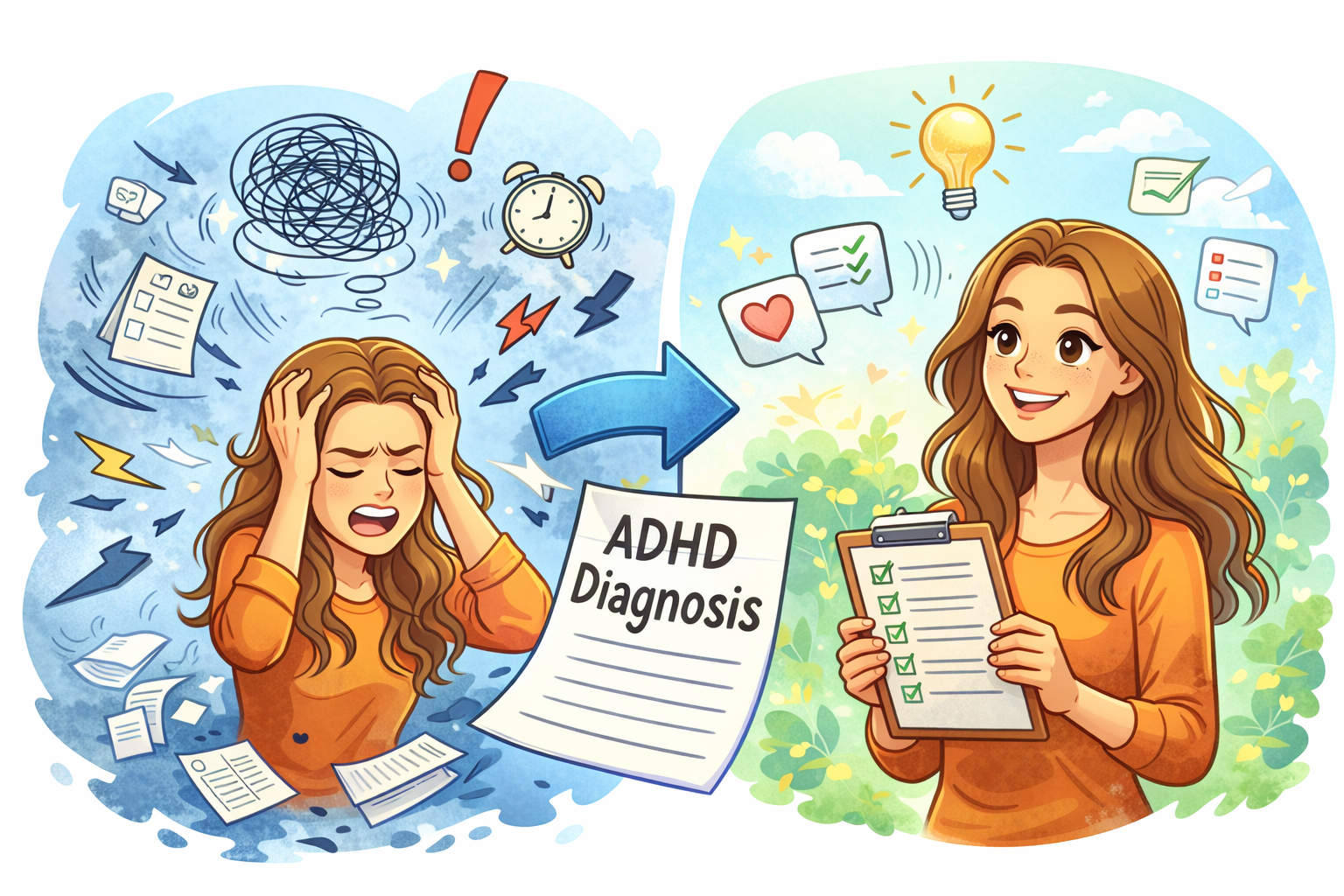
How clarity, access to support, and self-understanding can transform daily life for adults with ADHD
Many adults spend years navigating a world that wasn’t built for their brain without ever knowing why it feels harder. For those whose ADHD goes unrecognized into adulthood, a formal diagnosis can be profoundly impactful. It is more than a label — it’s a doorway to understanding, support, and empowerment that reshapes how people relate to themselves and the world.
1. Validation, Self-Understanding, and Identity
One of the most consistently reported benefits of an adult ADHD diagnosis is the sense of validation it brings. For years, many adults feel like they’re “doing something wrong” or not trying hard enough, because traditional explanations for struggles don’t fit. A diagnosis reframes lifelong patterns — from missed deadlines to emotional overwhelm — through a neurological lens rather than a moral one.
Qualitative research shows that adults diagnosed with ADHD often describe the experience as a revelation that provides coherence to experiences once seen as chaos or personal failure. Many report a shift toward self-compassion and increased ability to make sense of their life history after diagnosis (BMC Psychiatry Study).PubMed
2. Better Access to Support and Treatment
Diagnosis is often a prerequisite for accessing targeted interventions. While medication is not the only path, it is frequently part of a comprehensive treatment plan that also includes behavioral support, executive function coaching, and psychotherapy. Some adults find medication improves focus and regulation; others benefit more from structured skills work. Accessing a range of options expands the toolkit beyond trying to cope alone.
In research comparing adults with symptomatic ADHD versus those who have received diagnoses, diagnosed adults tended to report better work productivity, quality of life, self-esteem, and daily functioning than those without a formal diagnosis, likely aided by increased access to resources and treatment pathways.PubMed Central
3. Improved Quality of Life and Functioning
Multiple studies suggest that a formal diagnosis — and the supports that follow — can correlate with improved day-to-day functioning. A study from New Zealand found that adults with suspected ADHD but no diagnosis reported lower quality of life than those formally diagnosed, suggesting diagnosis itself may contribute positively, perhaps by facilitating supports, acceptance, and self-management strategies.Springer
In the same vein, research measuring mood and quality of life profiles suggests that those with ADHD who had received a diagnosis showed better mood symptom profiles and quality of life compared to those without prior identification of ADHD.PubMed
4. Enhanced Relationships Through Communication and Understanding
When adults understand their own ADHD, they also gain a vocabulary to help others understand them. Instead of conflicts being interpreted as “carelessness” or “laziness,” behaviors can be framed in terms of executive function differences — which often reduces shame and tension in relationships.
In qualitative research exploring adult ADHD diagnosis experiences, many participants noted that family members’ understanding of their behaviors evolved after diagnosis, which improved empathy and communication.Springer
5. Community, Identity, and Deeper Self-Knowledge
A diagnosis often opens the door to community — online groups, support forums, and in-person meetups where adults share strategies, stories, and emotional support. Many people express that connection with others who “get it” is deeply validating and helps them build identity beyond struggle.
This social belonging can itself be a protective factor for mental health, reinforcing that someone’s brain works differently, not defectively.
Conclusion: Diagnosis as a Turning Point
An ADHD diagnosis in adulthood is more than a clinical event. For many, it is a turning point marked by self-understanding, access to support, improved quality of life, and healthier relationships. While a diagnosis doesn’t erase challenges, it reframes them in ways that reduce shame and open pathways toward meaningful, adaptive support.
Whether the goal is self-compassion, workplace accommodations, therapeutic help, or simply the right language to describe one’s experience, a formal diagnosis can be a transformative step in an adult’s journey with ADHD.
References
Experienced consequences of being diagnosed with ADHD as an adult. BMC Psychiatry, vol. 15, 2015, https://pubmed.ncbi.nlm.nih.gov/25884685/. Springer
Comparison of Quality of Life, Productivity, Functioning and Self-Esteem in Adults Diagnosed With ADHD and With Symptomatic ADHD. PMC, https://pmc.ncbi.nlm.nih.gov/articles/PMC6935829/. PubMed Central
Suspected and diagnosed ADHD quality of life differences: an investigative study of New Zealand adults. Discover Psychology, 2025.Springer
The Impact of Adult ADHD on Quality of Life Profile. PubMed, https://pubmed.ncbi.nlm.nih.gov/28974134/. PubMed
The need for earlier recognition of ADHD in primary care: a qualitative meta-synthesis. PubMed, https://pubmed.ncbi.nlm.nih.gov/35477774/. PubMed